
India’s Healthcare System
India is ageing and ageing fast. With increasing life expectancy and better access to healthcare, more people are living longer than ever before. But living longer does not always mean living better. For many seniors, the later years are marked by chronic illness, reduced independence, and repeated hospital visits.
This is where the real gap lies. While India’s healthcare system has made significant progress in treating diseases, it has not evolved equally in supporting people who need long-term, comfortfocused care. This is where palliative care becomes the missing piece—one that focuses not just on survival, but on dignity and quality of life.
The Reality of Ageing in India
India’s elderly population is growing rapidly. According to estimates, the number of people aged
60 and above is expected to reach over 300 million by 2050. At the same time, noncommunicable diseases such as heart conditions, cancer, stroke, and dementia are on the rise.
Globally, the World Health Organization estimates that more than 56 million people require palliative support annually, yet a large proportion do not receive it.
In India, access to pain and palliative care is still limited, with only a small percentage of those in need receiving structured support. This creates a situation where patients continue to suffer from unmanaged symptoms, and families struggle to cope without guidance.
Why Dignity Matters as Much as Treatment
Healthcare is often seen through the lens of treatment—diagnosis, medication, and recovery. But for ageing individuals, especially those with chronic conditions, the definition of care changes.
Dignity becomes central.
Dignity means:
- Being free from unnecessary pain
- Maintaining independence where possible
- Living in a comfortable and respectful environment
- Having emotional and psychological support
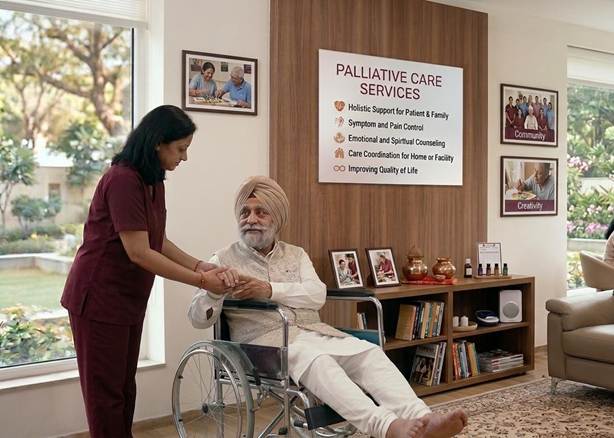
This is exactly what palliative care aims to deliver. It shifts the focus from “curing at all costs” to “living well despite illness.”
The Role of Pain and Palliative Care in Everyday Life
For many seniors, daily life is impacted by symptoms such as pain, fatigue, breathlessness, or reduced mobility. These challenges often go beyond what traditional treatment can address.
This is where pain and palliative care plays a critical role. It ensures that symptoms are managed proactively, not reactively. Patients receive continuous support, which helps them feel more stable and comfortable in their daily routine.
Over time, this leads to:
- Better sleep and reduced anxiety
- Fewer emergency situations
- Improved emotional well-being
Unlike episodic treatment, pain and palliative care provides continuity—something that is essential for long-term conditions.
Why Palliative Care in Hospital Alone Is Not Enough
Hospitals are designed for acute care emergencies, surgeries, and short-term treatment. While palliative care in hospital settings is important during critical phases, it is not always suited for long-term support.
Frequent hospital visits can be physically exhausting and emotionally stressful, especially for elderly patients. The environment itself can feel clinical and unfamiliar.
For ageing individuals, what is often needed is a stable, supportive environment where care is continuous and predictable. This is where care needs to extend beyond palliative care in hospital and move into structured, long-term care environments.
Understanding Care Home, Old Age Homes, and Senior Homes
In India, terms like Care Home, Old age Homes, and senior homes are commonly used and often refer to residential setups for elderly care. In the context of premium, professionally managed spaces, these terms are increasingly used interchangeably.
What truly matters is not the terminology, but the quality and structure of care provided.
A well-managed Care Home or structured senior living environment combines:
- Comfortable living spaces
- Daily support
- Clinical supervision
- Continuous monitoring
This ensures that palliative care is delivered consistently and effectively.
The Importance of Choosing an Established Provider
As the need for long-term care grows, so does the variation in quality across providers. Not all setups offering Old age Homes or senior homes are equipped to handle complex medical needs.
Choosing an established player becomes critical.
An experienced provider brings:
- Wider care network and accessibility
- Standard operating procedures (SOPs)
- Trained nursing and geriatric care specialists
- Emergency response systems
- Consistent monitoring and clinical governance
These factors ensure that pain and palliative care is delivered with reliability and accountability.
In India, a few organized players are building structured ecosystems around senior care. For instance, Antara Care Homes, part of a larger established group, offers professionally managed environments with better infrastructure, defined protocols, and continuous support across cities.
Such structured setups make a significant difference in delivering quality palliative care.
FAQs: Ageing and Palliative Care
- When should palliative care be considered for elderly patients?
Palliative care should be considered as soon as a chronic or serious illness begins to impact quality of life. Early pain and palliative care helps manage symptoms better and improves daily comfort.
- Is palliative care only provided in hospitals?
No. While palliative care in hospital is important during acute phases, long-term care is often more effective in structured environments like Care Home, Old age Homes, or senior homes with continuous support.
- How does palliative care improve dignity in ageing?
Palliative care focuses on comfort, independence, and emotional support. It ensures that elderly patients live with less pain, more stability, and greater respect for their needs.
Conclusion: Redefining Healthcare for an Ageing India
India’s healthcare system is at a turning point. As the population ages, the focus must shift from only treating illness to supporting people through every stage of life.
Palliative care is not just a service—it is a philosophy that places dignity, comfort, and quality of life at the center of care.
By strengthening access to pain and palliative care, integrating support beyond palliative care in hospital, and encouraging structured environments like Care Home setups, India can build a more compassionate and complete healthcare system.
Because in the end, ageing is not just about living longer—it is about living better, with dignity and care.


